

On Friday 12 June 2026, at Woolwich Crown Court, four remarkably courageous and principled members of Palestine Action were each condemned to five or more years of prison. They were punished for destroying around 40 lethal drones made by the genocide-enabling Israeli arms company Elbit Systems, a company that continues to operate in the UK with the full protection of the British legal system. The punishment meted out to these first four of the 25 Filton defendants sets a very grim and ominous precedent for the future of British civil liberties and our right to protest, including what remains of our highly restricted rights to protest heinous state crimes like genocide.
As the Filton case judge Jeremy Johnson explained in his almost cartoonishly punitive sentencing remarks late on Friday afternoon, technical justification for the exceptional sentences was provided by his attribution of a “terrorist connection” to the Filton operation.
This sent shockwaves of alarm all through the judicial system and related sectors. In the weeks leading up to 12 June, scores of outraged lawyers and law professors, along with many hundreds of educators, healthworkers, and artists, signed collective letters condemning such a brazen manipulation of anti-terrorism laws in particular and this government’s wider repression of political protest more generally.
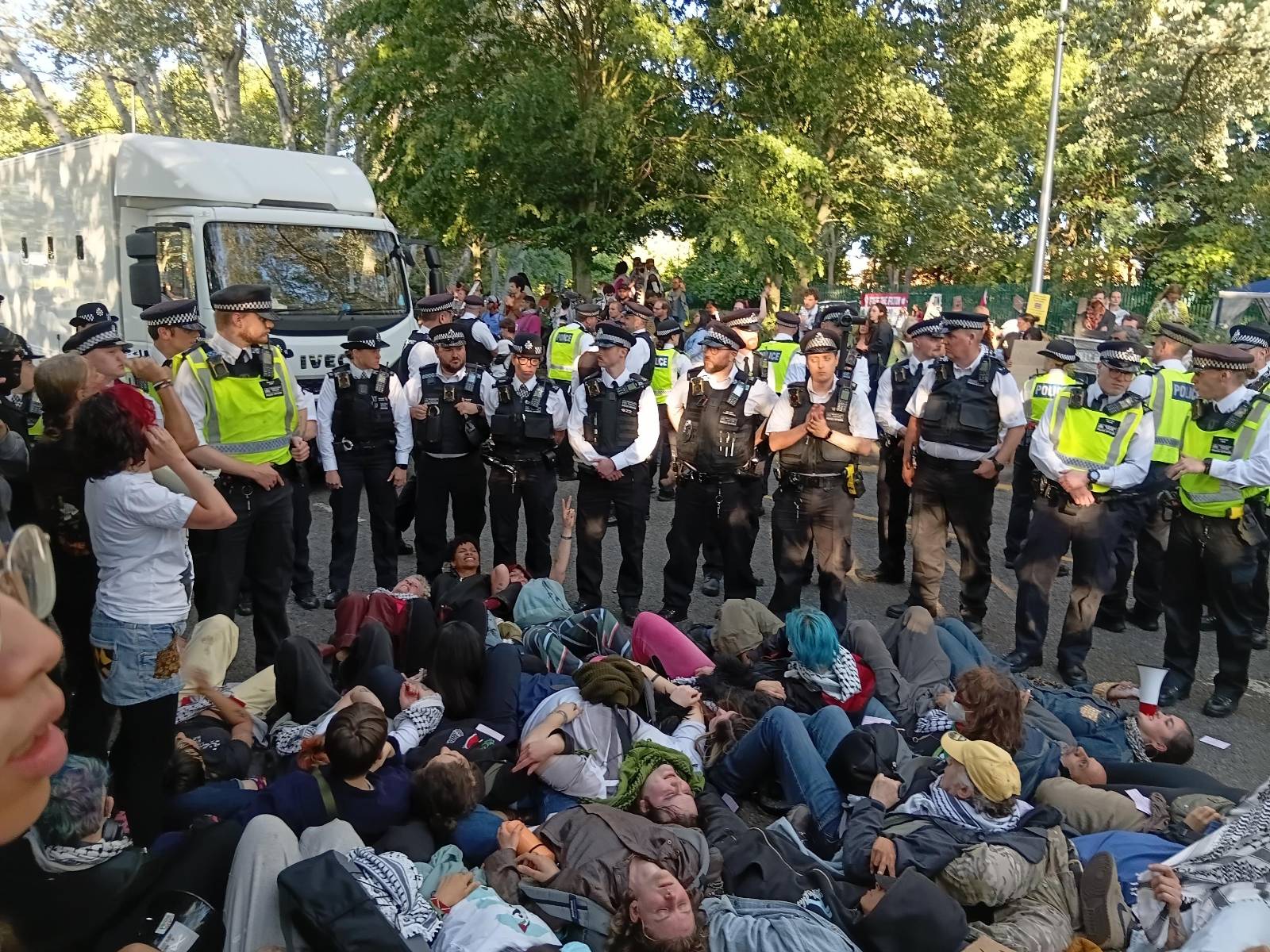
On 12 June itself, directly outside the fenced-off premises of Woolwich court, the Filton 25 campaign maintained a non-stop rally with one remarkable speaker after another from 10am to till 7:30pm. A few yards away, around 250 people strung out in a long line along the road participated in an act of mass civil disobedience organised by Defend Our Juries, holding placards that read: “Saving lives is not terrorism, I support Palestine Action.” (Only around a third of the sign-holders were arrested before the police, for reasons they didn’t explain, simply gave up on enforcing their so-called “anti-terrorism” law in mid-afternoon – leaving scores of apparent “terrorists” entirely at liberty on a busy London street).
Undeterred, late on the Friday afternoon, Johnson followed through on his plans to make a clear example of the Filton actionists, and gave all four of them sentences of extraordinary severity. He condemned Charlotte Head and Leona Kamio to a six-year “special custodial sentence,” which includes a minimum of five years’ jail time; he condemned Fatema Zainab Rajwani to the same sentence minus four months; he condemned Samuel Corner (who in addition was convicted of grievous bodily harm without intent) to a total sentence of almost nine years in custody.
Judge Johnson’s obscene judgement reads as a full-throated defence of genocide as a protected business model. Livestreamed by Sky News, his sentencing remarks were relayed in real time to the mass of stunned Pal Action supporters outside the court. He confirmed that it makes no legal difference whatsoever, as far as the British state is concerned, whether Elbit is making weapons of mass assassination or (to evoke an alternative mentioned during the trial by the Filton defence counsel) fluffy toys for children. “Throughout the case,” Johnson told the defendants, “you have sought to portray Elbit as a criminal company,” one engaged in crimes against humanity in Palestine, apparently forgetting that Johnson’s court has no interest in any sort of “political or legal argument about the role or conduct of Elbit in those events.” Since “Elbit is not on trial,” he continued, so then it would be “quite wrong for the court to make findings about its conduct in order to inform an evaluation of the seriousness of your offending.” All that matters, Johnson went on, is the exceptional seriousness of your own offense, compounded by its “exceptionally high degree of both planning and premeditation […]. The harm that you caused and intended to cause and the harm that your offending might foreseeably have caused were all exceptionally high,” thereby justifying the “significant upwards adjustment” to your sentences.
People who have more direct experience than Mr Justice Johnson of how Elbit’s products are actually used in Gaza might be forgiven for seeing things a little differently. The speakers who contributed to a brief press conference that took place outside the court immediately after Johnson’s pronouncement all tried to address the point that Johnson refuses to see. The Filton co-defendant Zoe Rogers (who was acquitted of criminal damage last month) quietly observed that the Elbit “weapons we destroyed will never be able to kill people. They will never be able to take away people’s parents, their friends, their children.”
Sukaina Rajwani (mother of the defendant Fatema Zainab Rajwani), noted that the British state has responded to Palestine Action as an intolerable threat to business as usual. “When the state holds 21-year-olds without trial for 19 months, stitches up a retrial, then locks them away as terrorists, you realise how scared they are – scared of Fatema Zainab, scared of Ellie, scared of Lottie, scared of Sam, scared of us, scared of our movement, scared of the community we have created, scared of their actions and resilience inspiring thousands more.”
Just as the Filton campaign’s press conference came to an end, the Serco van carting the four defendants off to their next stint in prison made an ill-timed attempt to drive out onto the main road, and was promptly blocked for more than an hour. For a long time it seemed like it would be stuck there indefinitely, as scores of campaigners refused to be cowed by the increasingly frustrated and violent police. Eventually enough of the people lying in the road were roughly dragged away and arrested, allowing the van to reverse and speed off in the opposite direction.
It’s incredible to think that the state’s vicious persecution of the Filton 25 and Brize Norton 6 is still only just beginning, as the next Filton trial started on Monday 15 June. Presumably the Crown Prosecution Service intends to take an even more draconian line against the BN6, who have already been subjected to exceptional forms of pre-trial punishment in prisons scattered across the country.
The trials continue, as the saying goes, and they are bound to continue for as long as British judges like Jeremy Johnson, along with British politicians like Keir Starmer and Shabana Mahmood, consider it more just and more important to enable rather than prevent the perpetration of genocide.

Leave a Reply